

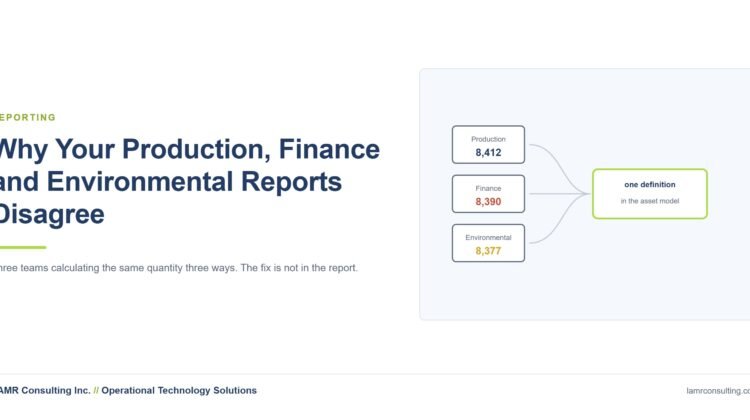
Why Your Production, Finance and Environmental Reports Disagree
A familiar scene: the monthly review, three numbers for what everyone believed was the same quantity, and forty minutes spent reconciling them instead of discussing the business. It happens in well-run organisations with competent people and good intentions.
It is almost never a reporting problem.
What is actually happening
Three teams needed the same quantity. Each extracted it independently, at a different time, with different boundaries, and made reasonable local decisions along the way. Production summed a tag from midnight to midnight plant time. Finance used the fiscal calendar. Environmental used a regulatory definition with specific rules about what counts during startup.
Each number is defensible. Each was produced by someone who understood their own requirement. They disagree because the definition was never written down in one place — it was implemented three times.
The usual suspects
- Time boundaries. Plant time versus UTC, shift boundaries versus calendar days, and what happens twice a year when the clocks change.
- Aggregation method. Time-weighted average versus simple mean over compressed data. These differ, and the difference grows with volatility.
- Treatment of bad data. One extract drops bad quality, another carries the last good value forward, a third treats it as zero. Each is a choice; rarely a documented one.
- Operating-state exclusions. Whether startup, standby and outage periods count — and whether the definition of those periods is shared.
- Unit conversion. Applied at different points by different people, occasionally twice.
Why fixing it in the report never works
The instinct is to reconcile at the reporting layer: adjust one report until it matches another. This holds until the next edge case, and it adds a correction that nobody will understand in two years. You have now got four definitions instead of three.
Where the definition belongs
The calculation belongs in the asset model, computed once, consumed everywhere. Defined on a template so it applies identically to every asset of that class. Carrying its boundary rules and bad-data handling with it. Visible, so somebody can read what it does rather than inferring it.
Then production, finance and environmental reporting all read the same attribute. If the definition is wrong, it is wrong in one place and gets fixed in one place.
A reasonable test
Pick your most-quoted operational number. Ask how many distinct implementations of it exist across your reporting estate. If nobody can answer quickly, that is the finding.
Then ask whether anyone can trace it from the published figure back to the source tags. If not, the problem will recur the next time it is challenged. How we approach reporting.