

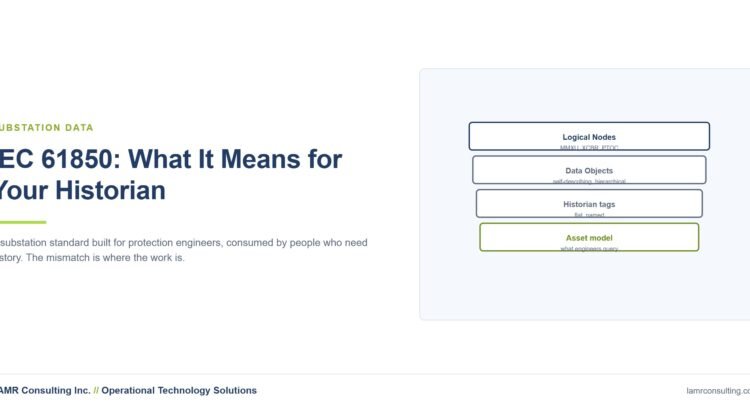
IEC 61850: What It Means for Your Historian
IEC 61850 was designed by protection engineers for protection engineers. It is self-describing, hierarchical and semantically rich — a circuit breaker announces itself as an XCBR logical node, a measurement unit as MMXU, with standardised data objects beneath. Compared with the protocols it replaced, this is a considerable improvement.
Then the data reaches a historian, which is flat. Tags have names and values. The structure that made 61850 worth adopting is discarded at the door.
What gets lost in translation
A typical substation gateway maps 61850 data objects onto a flat tag list, usually by concatenating the path into a tag name. The semantic model — that this measurement belongs to this logical node which belongs to this logical device which represents this physical bay — becomes a string.
The information is technically still there, encoded in the naming convention. But it is only machine-readable if every integrator across every substation used the same convention, which they did not.
Why this matters more as estates grow
- Fleet queries break down. Asking the same question of 200 substations requires 200 tag mappings unless the structure was preserved.
- New substations are bespoke. Each commissioning becomes a mapping exercise rather than instantiating a known pattern.
- Protection and process data stay separate. The people investigating an event need both, and they typically live in different systems with no common key.
- GOOSE and sampled values do not historise naturally. They were designed for sub-millisecond peer-to-peer messaging between protection devices, not for archiving, and attempting to store everything produces volume without insight.
The useful approach
Rebuild the semantic structure in the asset model rather than trying to preserve it in tag names. The Asset Framework hierarchy is where a bay becomes an element, a breaker becomes an element with a template, and the 61850 logical node structure is mirrored as something queryable.
Done once properly, the mapping becomes mechanical: a new substation is commissioned by instantiating templates and pointing attributes at the gateway’s tags. Done badly, every substation is a small project and the estate never becomes comparable.
Practical notes from the field
- Capture the SCL files (SSD, SCD, CID) during commissioning — they describe the substation’s data model formally, and they are far easier to obtain then than three years later
- Decide deliberately what to historise: steady-state measurements, yes; GOOSE traffic, almost never in its raw form
- Preserve quality attributes — 61850 carries rich quality information that most mappings quietly drop
- Standardise naming across integrators before the estate grows, not after
The substations will outlive several generations of data platform. The model is the part worth getting right. How we approach asset modelling.