

Substation Asset Health: What the Data Can and Cannot Tell You
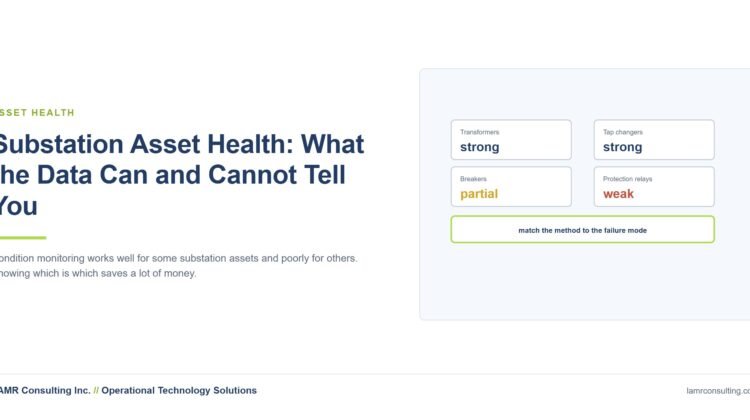
Substation condition monitoring is frequently sold as a single capability. In practice it works very well for some asset classes, moderately for others, and barely at all for a few — and the difference is determined by the physics of how each one fails, not by the analytics applied.
Where continuous data genuinely predicts condition
Power transformers are the best case. They degrade slowly, through mechanisms that leave measurable traces: dissolved gas ratios shift, winding and oil temperatures drift relative to load, moisture accumulates. The timescales are long enough that trending gives real warning, and the consequences of failure are large enough to justify the instrumentation.
On-load tap changers are similarly tractable. Operation counts, motor current signatures and contact temperatures all trend, and OLTC problems are a meaningful share of transformer failures.
Where it is partial
Circuit breakers sit in between. Operation counts, travel time and coil current signatures are informative, but breakers spend years doing nothing and then are asked to operate correctly once. The data tells you about accumulated duty rather than about the next operation specifically.
This is still worth having — duty-based maintenance beats calendar-based — but it is not prediction in the sense people often expect.
Where the honest answer is no
Protection relays largely fail in ways continuous process data does not see: firmware faults, setting errors, wiring problems found only during testing. Self-diagnostics and systematic testing regimes matter here. Trending a relay’s analogue values tells you about the power system, not about the relay.
Nobody benefits from a condition-monitoring programme that promises coverage it cannot deliver. It erodes confidence in the parts that do work.
The data problem underneath
Substation condition monitoring is unusually dependent on joining sources. DGA results arrive from a laboratory on a schedule. Load and temperature come continuously from SCADA. Operation counts come from the relay or breaker itself. Maintenance history lives in an entirely separate system.
None of these are useful alone. Dissolved gas concentration means little without the loading history that produced it. That join is the actual engineering work, and it is why a coherent asset model matters more than the choice of analytics.
A reasonable starting point
- Begin with transformers, where the ratio of value to effort is highest
- Get lab results into the same model as the continuous data before building anything clever
- Define condition indicators at asset-class level so they apply fleet-wide
- Be explicit about which assets are covered and which are not