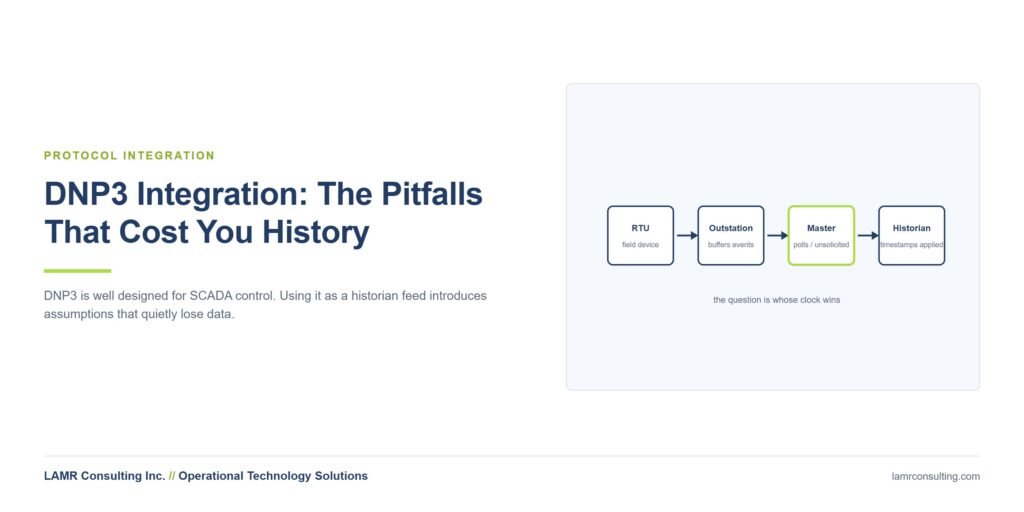
DNP3 was designed for SCADA: reliable supervisory control over constrained links, with a sensible event model and good handling of intermittent communications. It does that job well. The difficulties appear when the same link is treated as a historian feed, because the assumptions differ.
Whose timestamp are you storing?
This is the most consequential question and the most frequently unexamined. DNP3 outstations can timestamp events at source. Masters can timestamp on receipt. Historians can timestamp on arrival. These produce materially different data, particularly when communications are delayed.
If the historian is applying its own arrival timestamp to events the outstation timestamped minutes earlier, your archive records when you heard about the event rather than when it happened. For reliability analysis and sequence-of-events reconstruction, that is the difference between usable and misleading.
Class 0 polling is not a history feed
Integrity polls return current values for all points. Many integrations rely on periodic Class 0 polls and historise the results, which is simple and works — until something changes between polls. Event classes 1, 2 and 3 exist precisely so change is reported rather than sampled.
An estate that historises only poll results has a record with a resolution ceiling set by the poll interval, regardless of how fast the underlying measurement moves. People are frequently surprised by this when they come to analyse a fast transient.
Event buffer overflow
Outstations buffer events when the master is unreachable. Those buffers are finite. A long communications outage overflows them, and the oldest events are discarded — silently, by design.
The resulting gap in history looks identical to a period where nothing happened. Unless the outstation’s buffer-overflow indication is captured and historised alongside the data, nobody can distinguish the two afterwards.
Quality flags that nobody carries forward
DNP3 carries per-point quality: online, restart, communications lost, remote forced, local forced, over-range. Most integrations map the value and drop the flags.
A forced point reads as a perfectly ordinary measurement. An offline point holds its last value. Both look like a stable process to anyone — or any model — looking at the archive later.
What good integration looks like
- Use source timestamps where the outstation provides them, and record which timestamp source applied
- Subscribe to event classes rather than relying on integrity polls alone, with polls as a reconciliation mechanism
- Historise the communications state and buffer-overflow indications as data in their own right
- Carry quality flags into the historian rather than discarding them at the interface
- Verify behaviour by deliberately interrupting the link and confirming what the archive shows afterwards
The last point is the one most often skipped and the most informative. Protocols we have integrated.